Co-commissariat Musée d'art contemporain de AlUla & Centre Pompidou
"Arduna" brings together more than 80 works by Saudi, regional and international artists, as well as remarkable loans from the Centre Pompidou collection, and explores how artists have represented nature in modern and contemporary art. Co-organised by the future AlUla Museum of Contemporary Art and the Centre Pompidou, this exhibition is part of the fifth edition of the AlUla Arts Festival and will run from 1 February to 15 April 2026.
Organised into six thematic chapters, the exhibition takes visitors on a journey through different natural spaces.
The pioneering exhibition "Arduna" will be open to the public from 1 February to 15 April 2026 as part of the fifth edition of the AlUla Arts Festival. Presented by Arts AlUla and the future AlUla Museum of Contemporary Art, "Arduna" is an exhibition co-organised by the Centre Pompidou, with the support of AFALULA (French Agency for the Development of AlUla), bringing together more than 80 diverse works of art from Saudi Arabia, the Arab world and beyond. Arduna, which means "our land" in English, offers the public a glimpse into the curatorial vision of the future AlUla Museum of Contemporary Art, a global institution rooted in the cultural oasis and heritage of the region. The works on display come from the growing collection of the Royal Commission for AlUla (RCU), but also include remarkable pieces from the collection of the National Museum of Modern Art - Centre Pompidou.
Curated by Anna Hiddleston and Candida Pestana
RTIST'S COMMISSION
Renaud Auguste-Dormeuil's artistic practice unfolds at the intersection of time, memory and representation. Since the 1990s, he has sought to reveal the invisible structures that shape our understanding of reality and history by addressing the elusive concept of time through his art. At the heart of his practice lies an exploration of absence and disappearance, as well as a quest to represent temporal phenomena that resist direct visualisation, such as death, war and the irreversible course of history. For him, art is not only a testimony to the visible, but also a means of imagining what cannot be seen: the before and after of a historical rupture, the silent persistence of cosmic time.
This enduring commitment to time and memory finds profound expression in his photographic series The Day Before (2000?2010), which captures the starry skies as they appeared on the eve of air attacks such as those of 11 September, Hiroshima, Guernica and Sarajevo. The images evoke a moment of silence and stillness?a vast and indifferent cosmos suspended above the human tragedy unfolding below. By juxtaposing intimate, localised stories with the continuity of celestial time, The Day Before highlights the dissonance between lived trauma and the eternal expanse of the universe, capturing a moment when those who know are reflected or fractured by those who are still unaware of what is happening.
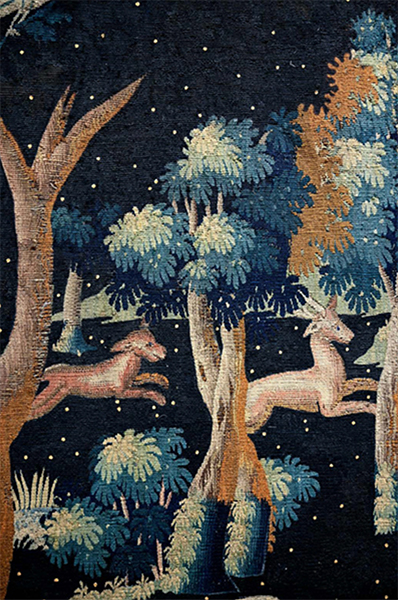
A superimposition of eras is also evident in Auguste-Dormeuil's tapestries. He acquired damaged or devalued Aubusson tapestries dating from the 16th to the 18th century and covered each one with the night sky as it was on the date of a historical event contemporary with the creation of the tapestry, reconstructed using astronomy software. Painted in Indian ink and gold gouache, these star charts disrupt the serenity of the original scenes, reproducing, for example, the sky above the Great Fire of London or the night sky at the time of the death of the Renaissance painter Caravaggio. The result is a visual palimpsest that condenses several moments into a single image. Through this process, Auguste-Dormeuil confronts us with the sad reality that once history is written, it cannot be erased: the passage of time is indelible, forever engraved in memory and in matter.
The artist's approach is reversed in his performance I Will Keep a Light Burning, which brings the past and present together towards the future. Candles are lit in an arrangement corresponding to the configuration of the stars as they will appear above the same site one hundred years after the performance. As the candles burn and eventually extinguish, only the photographs of the installation remain, emphasising how moments fade and disappear, surviving only in images. In this way, the work reveals the ephemeral illusion that is art itself ? not only as a testimony to what has been, but also as a gesture towards what can never be fully grasped, suggesting that representation is less about preserving reality than confronting its perpetual disappearance.
Ultimately, Auguste-Dormeuil's work invites us to perceive time not as a fixed narrative, but as a fragile constellation of moments: visible and invisible, remembered and forgotten. This work is a reflection on the nature of history and on the traces we leave behind, which bear the weight of what can never be erased.
More informations here